
As an Amazon Associate I earn from qualifying purchases.
Piano players often move around during performances as an expression of the emotion they feel from the music. Have you ever caught yourself tapping your foot or swaying to your favorite tune? That’s kind of what it’s like for pianists, except it’s on a more intense level.
They channel the music through their body movements, enhancing the connection between themselves and the piece they’re playing. This can range from subtle head nods to more dramatic sways or gestures that coincide with the dynamics and flow of the music.
Want to Learn Piano?Click Here

In my own experience, I’ve found that movement helps me to better engage with the music and convey its emotional depth to the audience. I remember during one performance of Chopin’s “Nocturne in C-sharp minor,” my body naturally began to mirror the ebb and flow of the melody.
As I hit the crescendos, my arms would lift slightly, and during the softer passages, I’d find myself leaning in closer to the keys. It wasn’t something I consciously decided to do, it was as if my body knew what the music needed to come alive.
This kind of physical response isn’t unique to me; it’s a widespread technique among pianists to embody the essence of the piece they’re playing. By moving with the music, pianists are not just playing notes; they’re telling a story and showcasing their personal interpretation of the piece.
It’s a beautiful blend of technique and passion that makes live piano performances so captivating.
Is Moving Around Actually Beneficial To Piano Players
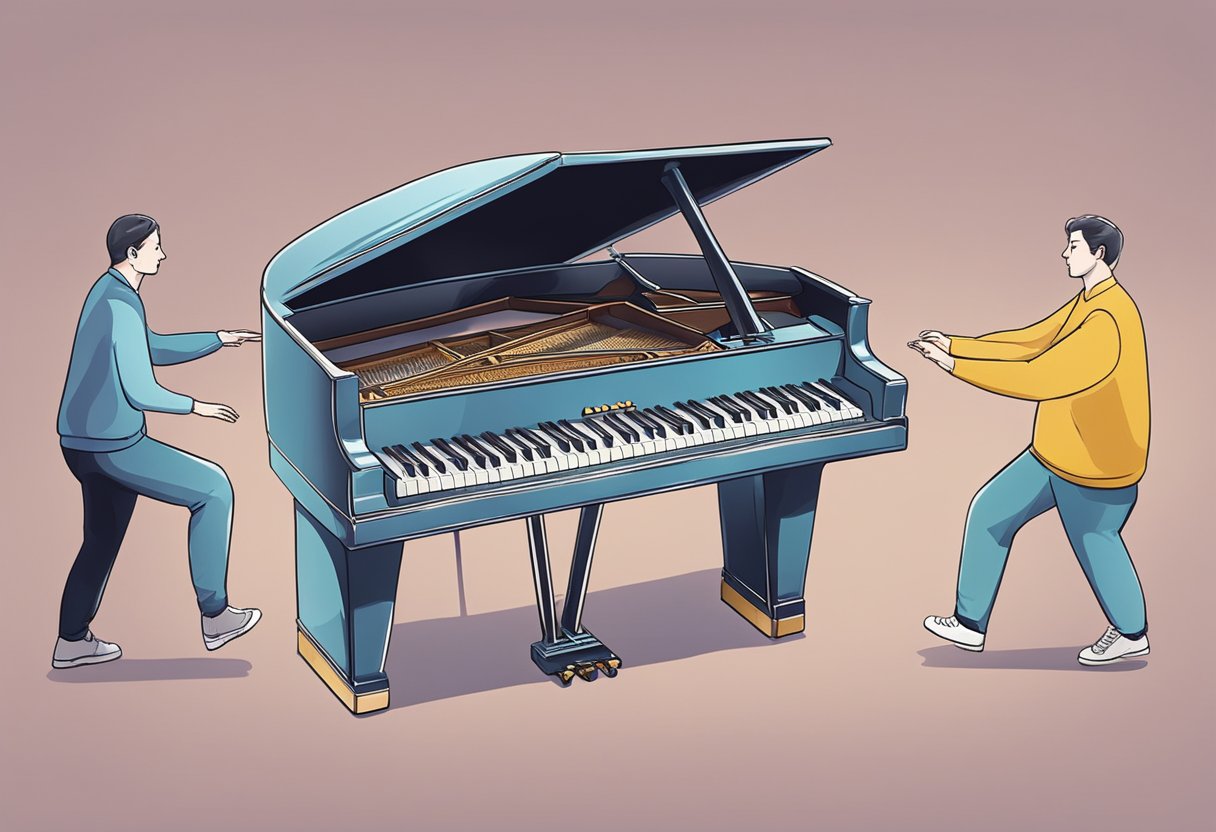
When I’m deeply engrossed in music, my body tends to mirror what my hands are doing on the keyboard. It’s not just me; this unconscious movement often aids pianists in expressing and connecting with the music.
Here’s why moving can be beneficial:
- Emotional expression: Conveying the music’s emotions becomes more intuitive when your body is involved.
- Memory aid: Body movement can act as a mnemonic device, helping to memorize pieces.
- Physical comfort: Fluid movements can prevent stiffness and promote ergonomic playing.
Imagine you’re at a piano, fingers gliding over the keys during a complicated passage. Instinctively, you lean forward, your body swaying with the crescendo and then pulling back as the melody softens. This isn’t just showmanship; it’s an extension of your musical instinct.
This movement creates a feedback loop that enhances your interpretation, helps you to anchor certain parts of the music in your muscle memory, and can even keep you more comfortable during long practice sessions.
To sum it up, moving around while playing the piano can definitely have its upsides. It’s all about finding that balance between expression, memory, and comfort.
Expressive Performance Techniques
When you watch pianists perform, their physical involvement—gestures, posture, and facial expressions—all serve a purpose. These techniques enhance the emotional impact of the music they play and communicate the essence of the pieces to their audience.
Emotional Expression Through Music
The piano is not just an instrument; it’s a medium for conveying deep emotions. Renowned pianists like Glenn Gould would immerse themselves in complex works such as the Goldberg Variations, using subtle dynamics and touch to express a range of feelings, from melancholy to exuberance.
Use of Body Language and Facial Expressions
Body language and facial expressions intensify the narrative of the music. Pianists like Lang Lang eloquently use these elements, making their performances visually compelling and emotionally resonant.
Incorporating Showmanship
Showmanship is about engaging the audience. When Liszt performed, his flair was not just about theatrics; it was a calculated effort to captivate and mesmerize those listening.
Posture and Positioning
Correct posture isn’t just about ergonomics; it also contributes to the quality of sound. The right bench height and distance from the keyboard can affect a pianist’s ability to deliver the piece as intended.
Hand and Finger Techniques
Every pianist has unique hand and finger movement techniques. These are honed through years of practice to improve dexterity and to execute pieces with the right expression and weight.
Pedal Usage and Dynamics
Effective pedal usage adds depth and resonance. Pianists like myself exemplify the intricate dance of the feet that modulates the piano’s dynamics, enhancing the overall musical expression.
Speaking from personal experience, I once spent weeks dissecting Franz Liszt’s Liebestraum. I focused painstakingly on my hand position and the weight behind each note to bring out the swirling emotions.
But it was during a small recital, where the soft press of the pedal and a subtle lean into the keyboard turned a routine performance into something far more expressive, that I truly understood how physicality becomes part of the musical story we tell.
Final Thoughts
I hope this post helps you understand more about how helpful it can be to move around as a pianist. Not only is it a deep connection to what you’re playing, but it actually makes playing much easier to do. Everything plays a part in a performance, and physical movement is just one of those many things.
Hello & thanks for stopping by! I’m a professional concert pianist and piano instructor. In the United States, I’ve given successful performances in several places including New York, Florida, Connecticut, & New Jersey, I have also performed internationally in Italy and made my Carnegie Hall debut in 2014. I enjoy blogging about the piano, the art of performance, general music, current events and the latest in music production.